
What Is Clinical Pilates Really?
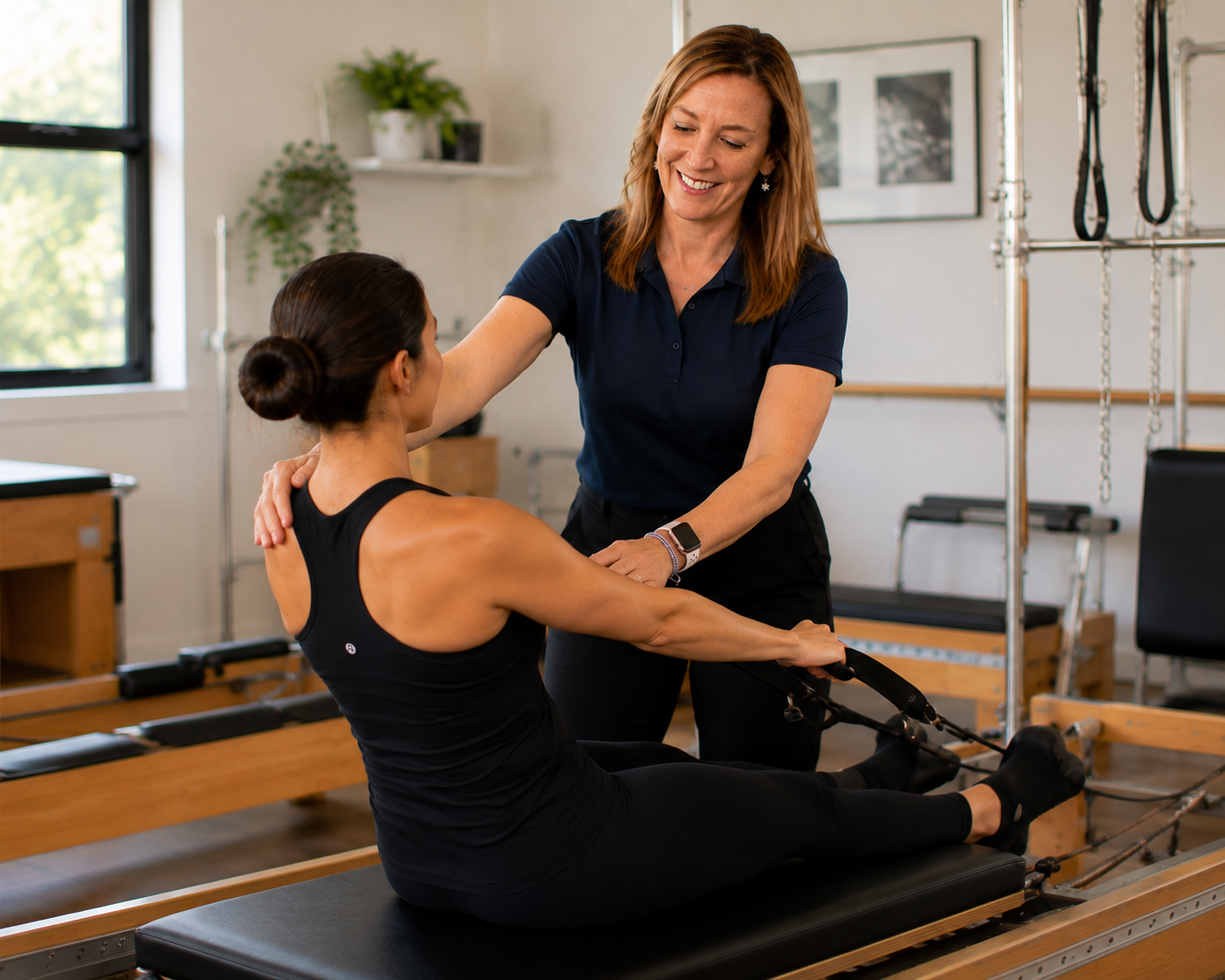
And why is it different from studio Pilates?
If you've ever wondered what the difference is between Pilates and Clinical Pilates, you're not alone.
The exercises can look very similar.
You might see a reformer, springs, a Pilates ball, bands or a mat. You might hear the same words—control, alignment, breathing, stability and movement.
So what actually makes Clinical Pilates different?
The answer isn't really the equipment.
It's the clinical reasoning behind the exercise.
Clinical Pilates starts with you
In a general Pilates class, the instructor usually teaches a program designed for the group.
Clinical Pilates starts somewhere different.
It starts with an assessment of you.
As a physiotherapist, I want to understand how you move, what is limiting you, what hurts, what you are trying to achieve and what your body is currently capable of doing.
I also want to understand your history.
Have you had an injury?
Are you recovering from surgery?
Do you have ongoing back or neck pain?
Are you managing osteoporosis, osteoarthritis or a neurological condition?
Are you trying to return to running, sport or simply move more confidently through everyday life?
All of this information helps determine what exercises are appropriate for you.
It's not about doing the "perfect" Pilates exercise
One of the things I love about Clinical Pilates is that there isn't one perfect exercise for everyone.
An exercise that feels fantastic for one person may not be appropriate for another.
Even two people with the same diagnosis may need completely different programs.
This is where physiotherapy assessment and clinical reasoning become important.
An exercise can be made easier.
It can be made harder.
The resistance can be changed.
The range of movement can be modified.
The position can be changed.
We can use different equipment.
Or sometimes, we choose a completely different exercise.
The exercise should serve the person not the other way around.
Clinical Pilates is about movement
I don't see Clinical Pilates as simply a way of strengthening your "core".
Your body doesn't move as a collection of separate muscles.
Movement is a team effort.
Your feet, ankles, knees, hips, pelvis, spine, shoulders and head all contribute. Your nervous system, balance, strength, coordination and sensory systems are constantly working together.
This is why a Clinical Pilates program may look quite different from what you expected.
Sometimes we're working on strength.
Sometimes we're working on mobility.
Sometimes we're challenging balance or coordination.
Sometimes we're improving confidence in a particular movement.
And sometimes we're doing several of these things at once.
Can Clinical Pilates make you stronger?
Absolutely but it depends on how it is prescribed and progressed.
Pilates can provide resistance and challenge your muscles, particularly when exercises are appropriately progressed.
However, I don't believe Pilates should be viewed as the only form of strength training.
As I've discussed in my recent articles, maintaining muscle strength is incredibly important as we age. Progressive resistance training has an important role in building and maintaining muscle.
Clinical Pilates can be one part of that bigger picture.
It can help develop strength, control, endurance, mobility and confidence and it can be particularly useful when we need to modify exercise around pain, injury, reduced mobility or other health conditions.
So, is Clinical Pilates for everyone?
Clinical Pilates can be adapted for a very wide range of people.
You don't need to be flexible.
You don't need to have done Pilates before.
You don't need to be particularly fit.
And you certainly don't need to be able to perform the exercises you see on Instagram!
The starting point should be appropriate for your body and your goals.
For some people, Clinical Pilates may form the main part of their rehabilitation.
For others, it may be one component of a broader program that includes walking, traditional strength training, balance work, cardiovascular exercise or a home exercise program.
What I want people to understand about Clinical Pilates
For me, Clinical Pilates isn't about performing complicated exercises or looking like a Pilates instructor.
It's about finding the right movement challenge for the person in front of me.
It's about understanding why we're doing an exercise not simply going through the motions.
And it's about progressively helping you become stronger, more capable and more confident in your movement.
Clinical Pilates is not about doing Pilates perfectly.
It's about using movement purposefully.